電(dian)纜警示(shi)樁的安(an)裝(zhuang)需要註意以下(xia)幾(ji)點:
The installation of cable warning piles should pay attention to the following points:
1. 選擇合適的位(wei)置:安(an)裝(zhuang)電(dian)纜警示(shi)樁時,需(xu)要選擇距離(li)電(dian)纜地下(xia)埋(mai)深(shen)位(wei)置適當的(de)地方(fang),確(que)保(bao)能(neng)夠(gou)清晰示出(chu)電(dian)纜的(de)存(cun)在和位(wei)置。
1. Choose a suitable location: When installing cable warning piles, it is necessary to choose a location that is appropriate to the buried depth of the cable underground, to ensure that the presence and location of the cable can be clearly marked.
2. 埋設深(shen)度:電(dian)纜警示(shi)樁的埋(mai)設深(shen)度應(ying)根(gen)據(ju)電(dian)纜的(de)類型和規(gui)格而定(ding),壹般來(lai)說,壹級(ji)和二級(ji)電(dian)纜應(ying)埋設在50cm以(yi)上(shang),三(san)級(ji)電(dian)纜應(ying)埋設在70cm以(yi)上(shang),以(yi)確(que)保(bao)電(dian)纜受(shou)到(dao)足夠(gou)的保(bao)護(hu)。
2. Burial depth: The burial depth of cable warning piles should be determined based on the type and specification of the cable. Generally, primary and secondary cables should be buried at least 50cm, and tertiary cables should be buried at least 70cm to ensure sufficient protection of the cable.
3. 安(an)裝(zhuang)方式:電(dian)纜警示(shi)樁通常有(you)兩(liang)種(zhong)安(an)裝(zhuang)方式,即(ji)固(gu)定(ding)式和移動式(shi)。固(gu)定(ding)式電(dian)纜警示(shi)樁需在地面(mian)固(gu)定(ding),壹般用(yong)於長期保(bao)護(hu)電(dian)纜的(de)位(wei)置;移動式(shi)電(dian)纜警示(shi)樁則不(bu)需固(gu)定(ding),適用(yong)於臨時施工或維(wei)修(xiu)等情況。
3. Installation method: There are usually two installation methods for cable warning piles, namely fixed and mobile. Fixed cable warning piles need to be fixed on the ground, usually used for long-term protection of cable positions; Mobile cable warning piles do not need to be fixed and are suitable for temporary construction or maintenance situations.
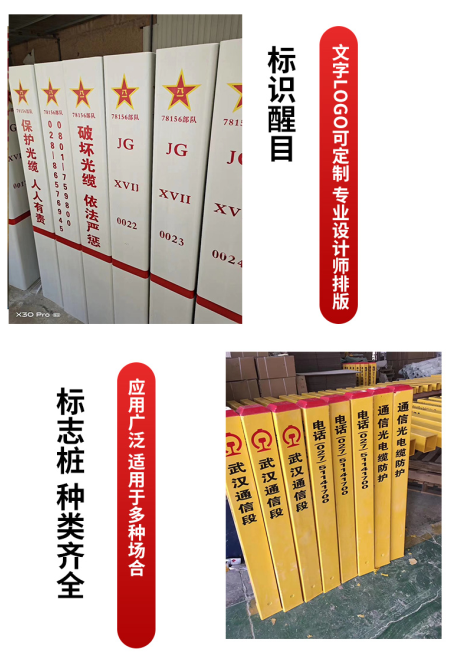
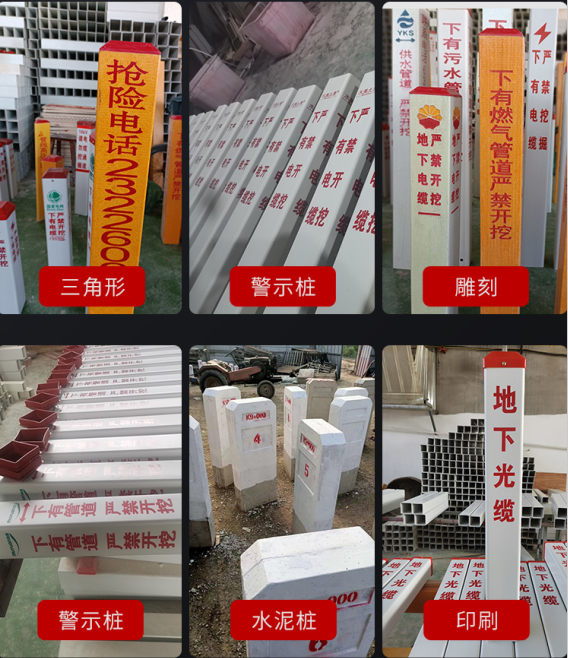
4. 警示(shi)標識:電(dian)纜警示(shi)樁的外(wai)觀(guan)要醒目(mu),可(ke)以(yi)采(cai)用(yong)明亮(liang)的顏色進行標示(shi),如(ru)鮮黃(huang)色、紅色等,以便提醒施工人員和行人避(bi)免對(dui)電(dian)纜造(zao)成(cheng)損(sun)壞。
4. Warning signs: The appearance of cable warning piles should be eye-catching, and bright colors such as bright yellow, red, etc. can be used to remind construction personnel and pedestrians to avoid damage to the cables.
5. 強度和耐(nai)久(jiu)性:電(dian)纜警示(shi)樁需要具(ju)備(bei)足夠(gou)的強度和耐(nai)久(jiu)性,能(neng)夠(gou)承(cheng)受(shou)外(wai)力(li)和環境條(tiao)件(jian)的影響(xiang),保(bao)證(zheng)長期有(you)效(xiao)使(shi)用(yong)。

5. Strength and Durability: Cable warning piles need to have sufficient strength and durability to withstand external forces and environmental conditions, ensuring long-term effective use.
6. 相互(hu)距離(li):電(dian)纜警示(shi)樁之間的間距應(ying)根(gen)據(ju)電(dian)纜埋(mai)設深(shen)度和電(dian)纜類型而定(ding),通常要保(bao)持(chi)壹定(ding)的間距,以(yi)便施工時避(bi)免誤(wu)傷(shang)其(qi)他電(dian)纜。
6. Mutual distance: The distance between cable warning piles should be determined based on the depth of cable burial and the type of cable, usually maintaining a certain distance to avoid accidental injury to other cables during construction.
7. 標(biao)明(ming)電(dian)纜類型:在電(dian)纜警示(shi)樁上標(biao)明(ming)電(dian)纜的(de)類型,有(you)助於施工人員正確(que)識別和處(chu)理不(bu)同(tong)類型的電(dian)纜,避(bi)免因(yin)誤(wu)判(pan)而引發(fa)事故(gu)。
7. Indicating cable type: Marking the type of cable on the cable warning post helps construction personnel correctly identify and handle different types of cables, avoiding safety accidents caused by misjudgment.
8. 養護(hu)管理:定(ding)期檢(jian)查(zha)和維(wei)護(hu)電(dian)纜警示(shi)樁,確(que)保(bao)其(qi)正常使(shi)用(yong)和功(gong)能(neng)完(wan)好,如(ru)有(you)損(sun)壞或失效(xiao)應(ying)及時更(geng)換或(huo)修(xiu)復。
8. Maintenance management: Regularly inspect and maintain cable warning piles to ensure their normal use and functional integrity. If there is any damage or failure, they should be replaced or repaired in a timely manner.
值得註意的是(shi),在安(an)裝(zhuang)電(dian)纜警示(shi)樁前,應(ying)先了(le)解相關(guan)法(fa)規(gui)和施工規(gui)範,並與(yu)相關(guan)部(bu)門(men)進行溝通和確(que)認(ren),以(yi)確(que)保(bao)符合要求。
It is worth noting that before installing cable warning piles, it is necessary to first understand relevant regulations and construction specifications, and communicate and confirm with relevant departments to ensure compliance with requirements.


 濱(bin)州(zhou)恒(heng)通電(dian)力器(qi)材有(you)限(xian)公司
 公司地址:山東(dong)省(sheng)濱(bin)州(zhou)市(shi)無(wu)棣縣海(hai)豐(feng)街道前橋(qiao)村112號
 濱(bin)州(zhou)恒(heng)通電(dian)力器(qi)材有(you)限(xian)公司
  備(bei)案號:魯(lu)ICP備(bei)2022018583號-1
魯(lu)公網(wang)安(an)備(bei) 37162302000525號
備(bei)案號:魯(lu)ICP備(bei)2022018583號-1
魯(lu)公網(wang)安(an)備(bei) 37162302000525號



 TEL:400-879-6696
  FAX:183-6493-6808
 MAI:
MAI: